Flavour science · Tempering
When Ingredients Meet Heat
By Sandhya Ravichandran · 5 min read
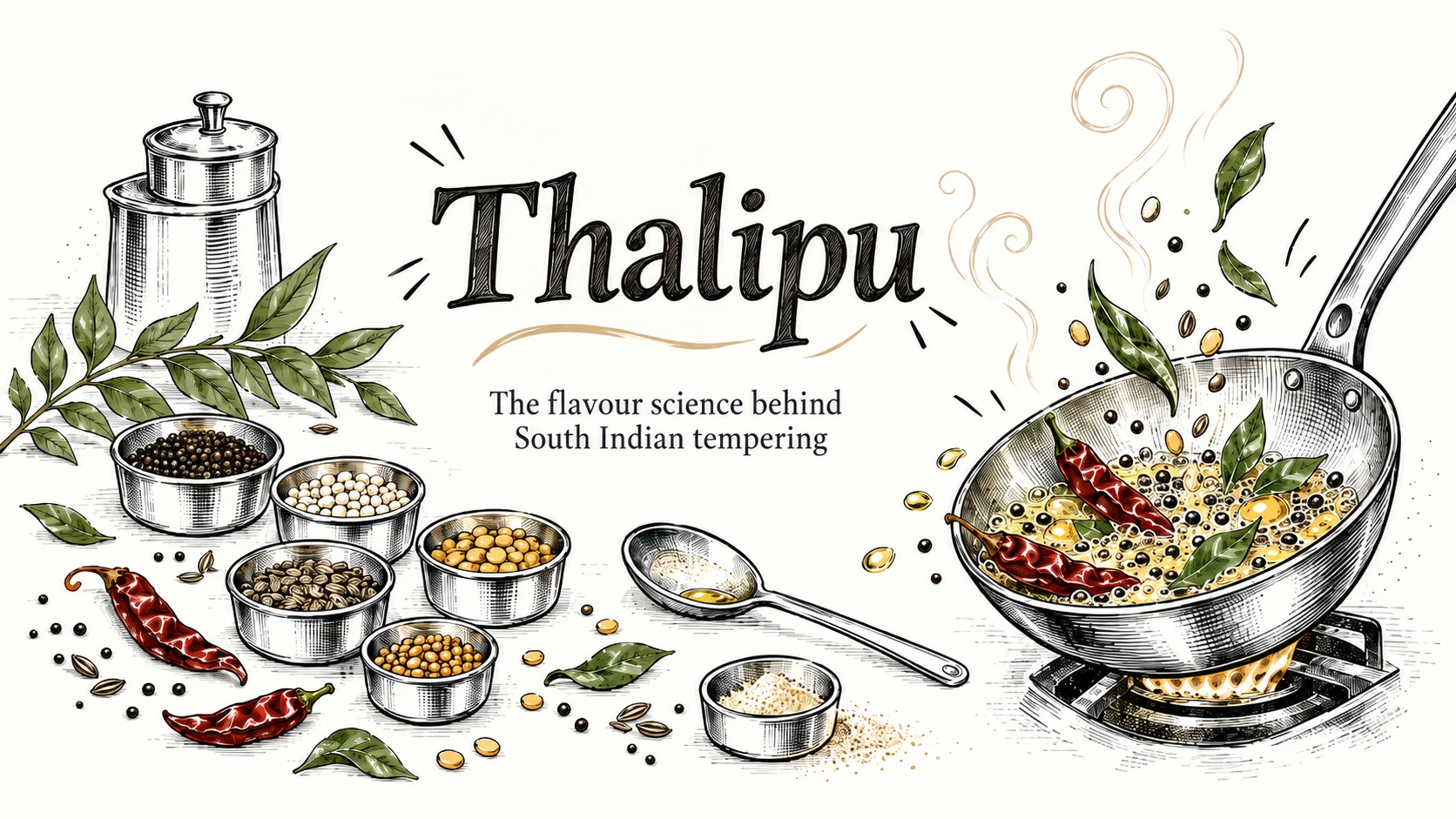
Tempering — thaalippu, tadka — is one of the quickest flavour-building techniques in South Indian cooking. The anjarapetti holds the everyday ingredients, and tempering is where those small ingredients are transformed by heat into aroma, texture and flavour.
A little hot oil, a few ingredients, and within seconds the kitchen smells completely different.
But what is actually happening?
Tempering is not one single chemical reaction. It is a combination of heating, moisture loss, aroma release, browning, fat extraction and physical changes, and each ingredient behaves differently.
What happens to each ingredient
Mustard seeds — why do they pop?
Mustard seeds contain a small amount of moisture. As the seeds heat in oil, that moisture turns to steam and pressure builds inside the seed.
Eventually the seed coat ruptures — and we hear the familiar pop.
At the same time, heating changes the way mustard’s characteristic aroma compounds are released and perceived.
That popping sound is therefore more than just a cooking signal. It tells us the seed has reached a stage where heat has significantly changed its physical structure.
Cumin seeds — toasty aromatic compounds
Cumin behaves differently from mustard. It does not need to pop; it toasts quickly and releases volatile aromatic compounds into the hot oil.
Its warm, earthy aroma develops fast, so it should not sit too long in very hot oil or it can turn bitter.
Urad dal and chana dal — from pale to nutty
They do not pop, but gradually turn golden and develop a toasted aroma.
Heating drives off moisture and promotes browning reactions, including Maillard chemistry, between amino compounds and reducing sugars.
These reactions create new aroma molecules that we perceive as roasted, nutty and savoury.
This is also why timing matters. Golden dal tastes pleasantly toasted; dark brown dal can quickly become bitter.
Curry leaves — aroma released into fat
Fresh curry leaves contain many volatile aroma compounds.
When they hit hot oil, the water present in the leaves rapidly vaporises — hence the dramatic sizzling.
At the same time, heat helps release aromatic compounds from the leaf, and the oil acts as a medium that can dissolve and distribute some of those fat-compatible aroma molecules through the dish.
That is why curry leaves smell so much stronger after tempering than when simply held raw in the hand.
Chilli — heat and aroma
Chilli contributes both aroma and pungency.
Its heat comes mainly from capsaicinoids, including capsaicin. These compounds are more soluble in fat than in water, so cooking chilli in oil helps distribute the pungency through the dish.
Heat also changes the chilli’s aroma. Brief heating can deepen its roasted character, but excessive heat quickly gives burnt, harsh notes.
Asafoetida — from sharp to savoury
Raw hing has an extremely strong sulfurous aroma.
Its characteristic smell comes largely from sulfur-containing volatile compounds.
When heated briefly in fat, the aroma profile changes and disperses through the oil. The sharp raw smell becomes more integrated into the dish, contributing a savoury, onion-garlic-like complexity.
Because its aroma compounds are powerful, only a very small amount is needed.
Fenugreek — bitterness with a narrow window
Fenugreek seeds naturally contain bitter compounds and distinctive aroma molecules.
Gentle roasting can make them smell warmer and more complex, but they burn easily. Once overheated, their bitterness becomes much more dominant.
This is a good example of why tempering is partly about temperature control and timing, not just ingredient choice.
Tempering is controlled transformation
A few seconds of sizzling is actually a sequence of different physical and chemical events:
- Mustard
- pressure builds and the seed pops
- Cumin
- rapid toasting and aroma release
- Dal
- browning and toasted, nutty aromas
- Curry leaves
- moisture vaporisation and volatile aroma release
- Chilli
- capsaicin dispersion and toasted aromas
- Hing
- sulfur-containing aromas disperse through the oil
- Fenugreek
- controlled roasting, aroma development and bitterness
That is what makes tempering so interesting.
The same oil, the same heat — but every ingredient responds differently.
And that is exactly where cooking becomes flavour science.
What is the role of oil?
Oil does three important things:
- Transfers heatHelps ingredients cook evenly.
- Carries aromaAbsorbs and lifts essential flavours.
- Spreads flavourDistributes taste through the dish.
Ingredients do not all tolerate heat in the same way.
So the order of tempering ingredients is not arbitrary. It is a practical way of exposing each ingredient to roughly the amount of heat it needs.
Why the order matters