Issue 1
Arusuvai — Where Tradition Meets Taste
By Sandhya Ravichandran · 5 min read
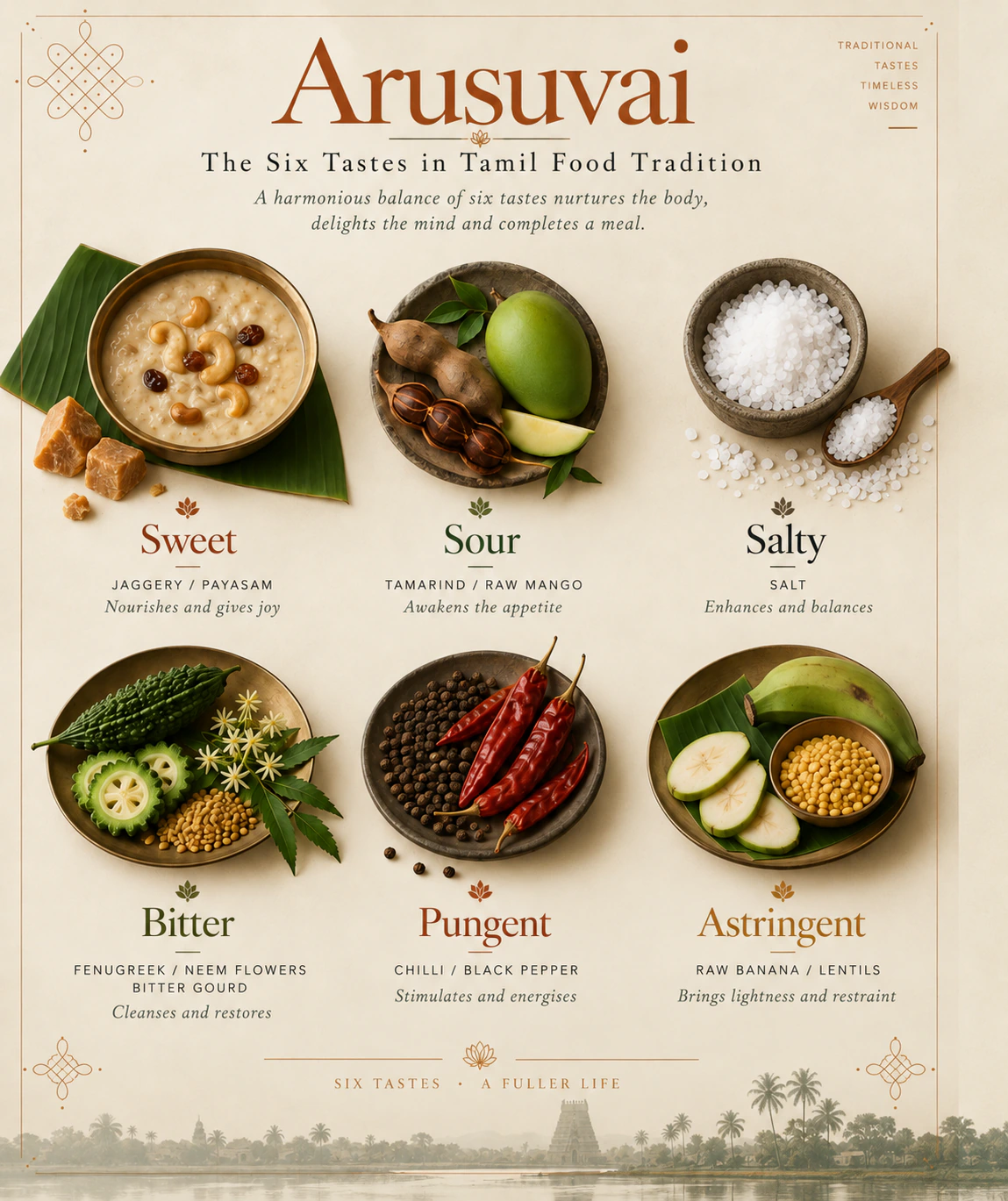
Arusuvai means “six tastes” in Tamil. Traditionally, these six are:
Sweet • Sour • Salty • Bitter • Pungent • Astringent
This concept of Arusuvai is deeply rooted in Tamil food traditions and reflected on Tamil New Year's Day, which falls around the 14th of April every year.
Where tradition meets science
What I find especially interesting is that traditional ideas such as Arusuvai and modern sensory science do not always describe these sensations in exactly the same way.
Sweet, sour, salty and bitter are considered basic tastes in modern sensory science.
Pungency, such as the heat from chilli or pepper, is experienced differently — it is linked more closely to the way certain compounds stimulate heat and pain receptors.
Astringency is also different. It is often experienced as a dry, puckering sensation in the mouth rather than as a basic taste.
And yet, in a meal, we experience all of these sensations together.
A beautiful example of Arusuvai is mangai pachadi, made with raw mango.
The raw mango brings sourness. Jaggery adds sweetness. Chilli contributes pungency. Salt balances the dish. In some traditional versions, neem flowers introduce bitterness.
What makes the dish interesting is not simply that several tastes are present, but that they are brought together in a way that creates a much more complex experience than any one of them could provide alone.
Although when we speak about Arusuvai, it does not necessarily mean that every dish — or even every meal — must contain all six tastes in equal measure.
For me, Arusuvai is all about balance.
A small amount of one taste can soften another. A touch of sweetness can round out sourness. Bitterness can add depth. Pungency can lift an otherwise mild dish. Salt can bring different flavours together.
It is less about ticking off six categories and more about understanding how different tastes can support, contrast and complement one another without one overpowering the whole meal.
Another example is vathakuzhambu.
This is a dish that can be strongly sour and pungent, often driven by tamarind, chilli and spices. Fenugreek or certain vathal can introduce bitterness, while salt gives structure to the overall flavour.
In some recipes, a small amount of jaggery is added — not to make the dish sweet, but to soften and round out the sharper edges.
That tiny amount can completely change how the dish is perceived.
This is what fascinates me about South Indian cooking: sometimes balance comes not from equal quantities, but from small adjustments that change the entire experience of a dish.
Why Arusuvai?
I wanted to begin with Arusuvai because it represents what I hope to explore through this space.
South Indian cooking is not only about recipes. It is about ingredients, balance, memory, technique and the small decisions that shape flavour.
Sometimes I will look at the chemistry behind an ingredient.
Sometimes I will look at the story behind a traditional recipe.
And sometimes, as with Arusuvai, I want to look at where traditional knowledge and modern flavour science meet.
Traditional food knowledge often describes how a meal feels as a whole, while science allows us to look more closely at what is happening in the mouth, on the tongue and in the nervous system.
For me, neither replaces the other. That is where this journey begins.