Flavour science · Oils
Why Does Fat Carry Flavour?
By Sandhya Ravichandran · 4 min read
How oils shape aroma, texture and the way we experience food
Oil and Indian cooking are almost inseparable.
In South Indian cooking especially, the fat we choose is often more than a cooking medium. Sesame oil in a kuzhambu, coconut oil in a Kerala-style preparation or ghee over hot pongal can completely change the character of a dish.
The fat we choose — and the way we use it — influences aroma, texture, heat transfer and flavour perception.
So what exactly is happening?
Oil can do several things at once:
- transfer heat
- extract and carry aroma compounds
- change mouthfeel
- help flavour spread through a dish
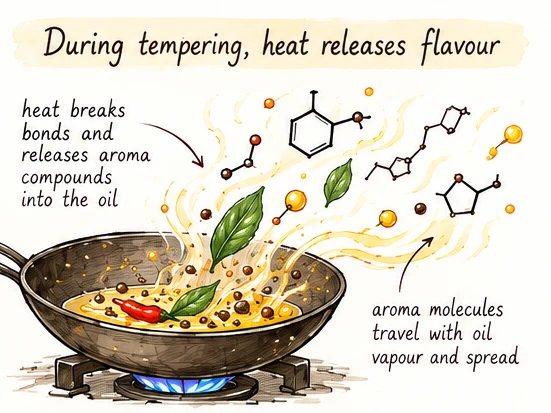
This is especially clear during tempering.
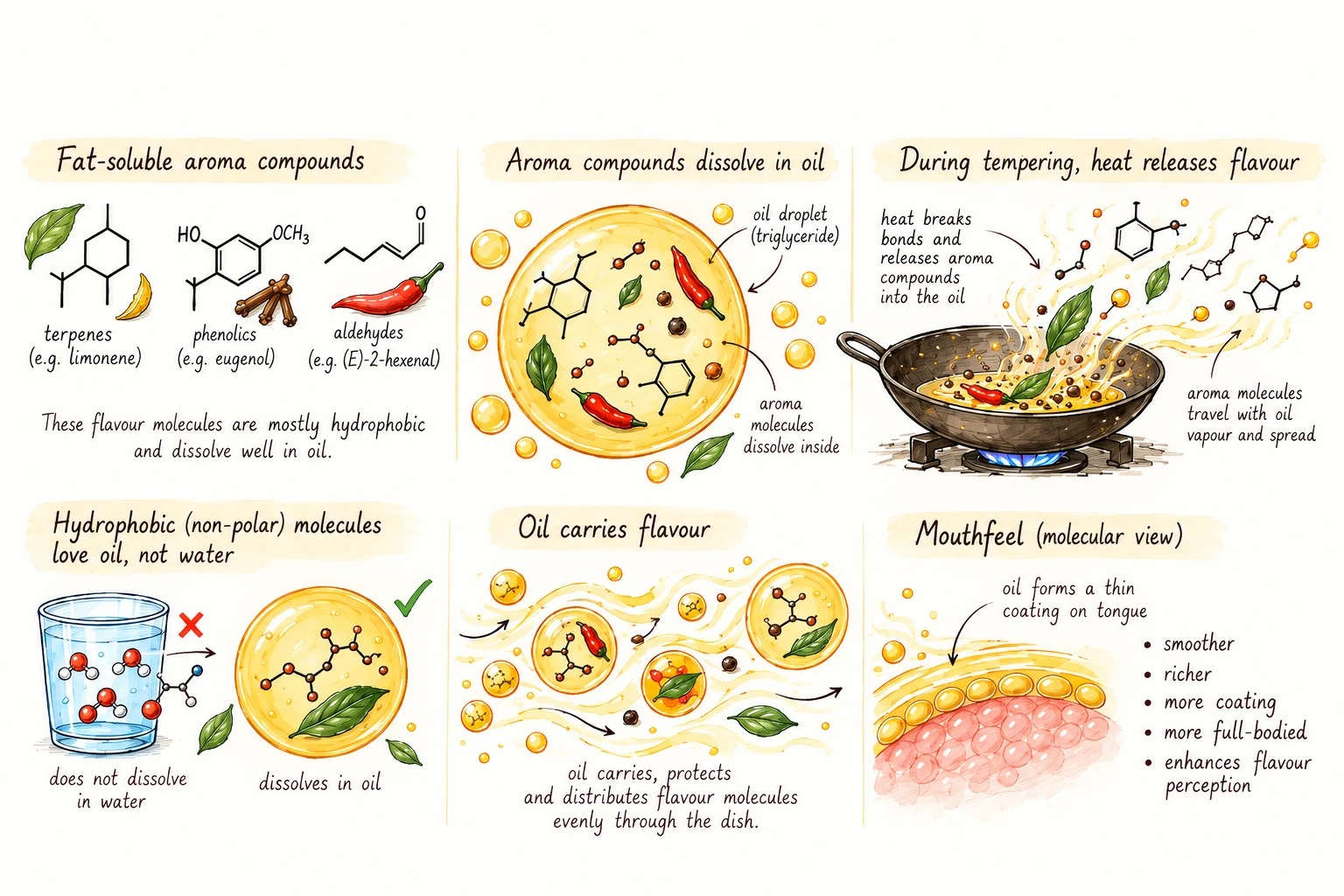
Many aroma molecules do not behave equally well in water and fat.
Some are relatively hydrophobic, meaning they interact more readily with fats than with water. When they dissolve into the fat phase, oil can help distribute them through the dish.
This is one reason a small quantity of spices heated in oil can influence an entire pot of food.
But fat does not simply make every aroma stronger. It can also affect how and when aroma compounds are released while we eat.
So rather than thinking of fat only as an amplifier, it is useful to think of it as part of the flavour-delivery system.
Flavour is more than taste
Our tongue detects basic tastes, but much of what we casually call “taste” is actually aroma perceived through the nose.
Fat can influence that experience by interacting with aromatic molecules and changing how they are released.
That is why changing the fat in a familiar dish can make it feel surprisingly different — even when the spice mixture remains the same.
Fat changes mouthfeel too
Fat can make food feel:
- smoother
- richer
- more coating on the palate
- more full-bodied
That coating effect can also change how long flavours seem to linger in the mouth.
A dish cooked with ghee therefore does not feel the same as one cooked with a neutral oil, even before we consider the aroma of the ghee itself.
The same spices, a different oil
And what about heat?
Different fats behave differently when heated.
The cooking method and the oil itself both matter.
The smoke point tells us when visible smoke begins to appear, but it does not tell us everything about how an oil behaves during cooking.
Its stability also depends on factors such as:
- fatty-acid composition
- degree of refining
- natural antioxidants
- heating time
- repeated use
An oil can begin undergoing chemical changes before visible smoke appears, so:
higher smoke point ≠ automatically better oil
Traditional oils and modern kitchens
An unrefined oil usually retains more of its natural aroma and flavour.
A refined oil is generally milder, and its behaviour during cooking can differ because some compounds are removed or altered during processing.
For me, choosing an oil is not about labelling one traditional oil as “good” and another as “bad”.
It is about understanding what the oil contributes, how it is processed, how it behaves during cooking and how much of it we use.
It may look like one of the quietest ingredients in the pan, but chemically and sensorially, they can shape the entire dish.
Oil is not just where the cooking happens. Sometimes, it is part of the flavour architecture itself.